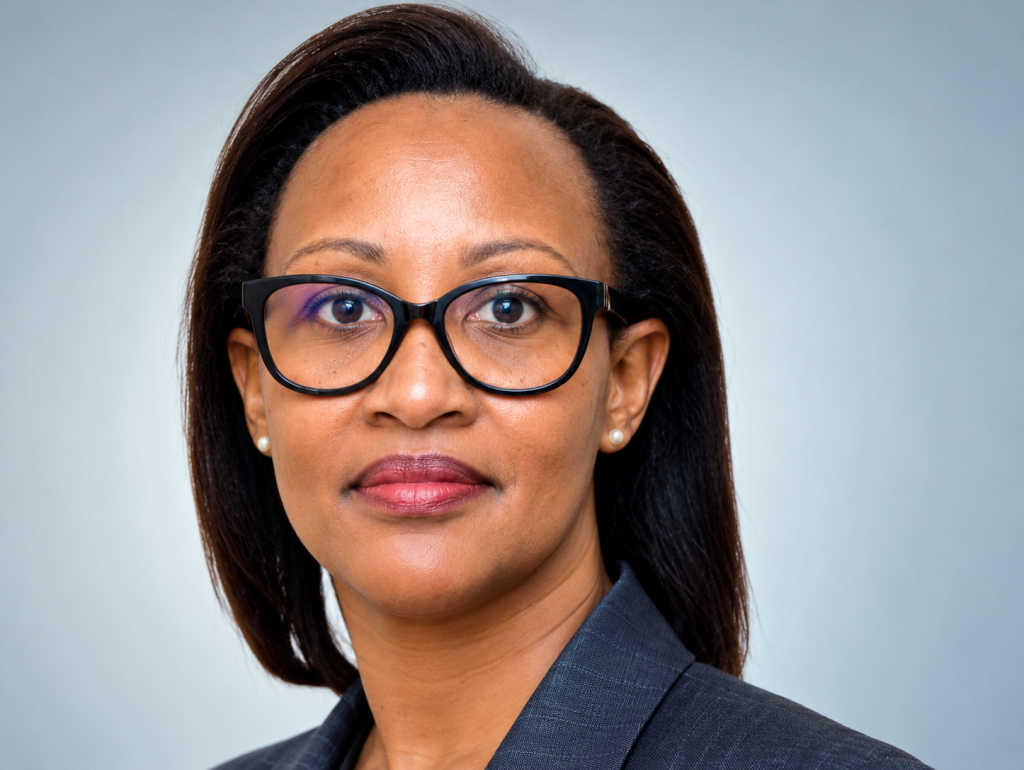
Aline Mutambuka, CHRO at I&M Bank Rwanda, has spent her career standing her ground in rooms where the stakes were high. It took a cancer diagnosis to show her what that quality is truly built on.
Aline Mutambuka, CHRO at I&M Bank Rwanda, has taken on an unexpected role outside the office. She is part of a team overseeing the construction of a church in Rwanda, meeting engineers, coordinating designs, mobilising people and following up on pledges. Last month, the team raised 100 million Rwandan francs in a single fundraising drive, and Aline is now pushing to break ground by December.
It is a different side of Aline, whose life outside work has taken a new direction in recent years.
“I used to go and take my glass of wine but I'm no longer part of it. I took another hobby and I feel like this is another call,” she says.
Career shifts
Aline has never been afraid to stand her ground. She has built HR functions across three countries and helped colleagues grow into heads of HR at other institutions. She began as a management trainee for a group based in Amsterdam, went through a marketing track and was posted to Rwanda as a brand manager for soft drinks with Coca-Cola. When Coca-Cola needed someone to fill an internal position and proposed her for the HR team, she accepted, drawn in by the scale of what was being built.
“It was a period of transformation, marked by the launch of several key initiatives, including organisational restructuring, job classification, salary alignment, and comprehensive salary surveys. I knew that if I was not facing new challenges or working on impactful projects, I would quickly become bored. For me, it was exactly the right opportunity at the right time,” she recalls.
That first project was significant, reducing the institution’s workforce from 1,050 to 575 employees while creating a more efficient organisational structure. Building on this experience, Aline progressed into a commercial director role before spending seven years in the telecommunications sector with Orascom and Econet Wireless in Burundi. There, she held a broad leadership portfolio encompassing human resources, administration, and procurement, further strengthening her reputation as a commercially minded business leader with a talent for driving organisational transformation.
During her seven years in the telecommunications industry, she managed fuel distribution contracts for telecom antenna sites and negotiated volume discounts with Engen, significantly reducing fuel and maintenance costs across 300-kilometre service routes. Her commercial acumen earned recognition from the Group, which commended her for thinking like a business leader rather than a mere functional head.
When political instability in Burundi forced her hand, she went back to Rwanda and joined Equity Bank Rwanda, where she would face the most consequential moment of her career. Equity Bank Rwanda was the eighth bank on the market when Aline joined. Within two years of her arrival, it had climbed to second in profit before tax. The work was relentless, addressing attrition by aligning salaries with the market, running three training sessions a week, cutting unnecessary costs, hiring from competitor institutions and pushing staff to think like business people.
Business first
That experience reinforced her belief that HR professionals must understand the business they serve
“My advice to every HR professional is simple, understand the business. Once you truly understand how the business operates, people will respect your contribution. When a manager comes to you requesting additional staff, your first question should be: Why do you need more people? What impact will these hires have on the business? What is the productivity level? These are conversations HR must be comfortable having,” she says.
Aline is a cancer survivor, a diagnosis that arrived quietly and unexpectedly. At the time, she was focused on supporting two colleagues through their own health challenges. During a routine medical check-up in Brussels in December 2023, her doctor attempted to reach her with the results. She was in a meeting and, caught up in the demands of work, only returned the call three days later.
The months that followed tested her resilience in ways few professional challenges ever could. Her first surgery took place on 15 November 2024. Just five days later, she was presenting to the board, determined not to let her illness define her. A second surgery followed on 12 December 2024, and the third on 27 December 2024.
Despite her commitment to her responsibilities, the experience taught her one of the most important leadership lessons of her life: the necessity of self-care.
“Sometimes, you need to make a conscious decision to stop and take care of yourself,” she emphasizes. “Otherwise, you find yourself caught in the middle, unable to give your best at work and unable to focus properly on your treatment. Taking care of your health is not a luxury. It is a necessity.”
Her recovery took two months, during which she lost 12 kilograms. Even after returning to the office, she was unable to sit comfortably for extended periods and would often leave work at around 2 pm to rest. Gradually, her strength returned, and with the support of a physiotherapist, she rebuilt the muscle mass she had lost during her recovery. Today, she says she feels no different from the Aline she was before October 2024.
Choosing herself
Reflecting on that chapter of her life, Aline says it left her with lessons she now shares freely with others.
“I learnt three important lessons during that season, and I share them with anyone willing to listen. One is your relationship with God because, when you are in hospital, you spend a lot of time alone with your thoughts. It is also during difficult times that you discover who your true friends are, the people who check on your children, visit them, and support your family when you cannot,” Aline notes.
Aline also emphasises the importance of saving, encouraging people to put aside a portion of their income regardless of how much they earn, as savings can provide a financial cushion when unexpected needs arise.
“Even if you earn 200,000 francs, save 20,000. You never know when those savings may one day save you,” Aline says.
Beyond her personal health journey and the demands of boardroom leadership, one of Aline's most enduring passions is mentoring others. For her, true leadership is measured not only by personal achievements but also by the success of the people she has supported along the way.
“I consider these to be among my greatest achievements,” she says. “There is no need to hold on to people indefinitely. It is far more rewarding to know that I played a role in helping someone grow, succeed, and move on to greater opportunities,” she says.