
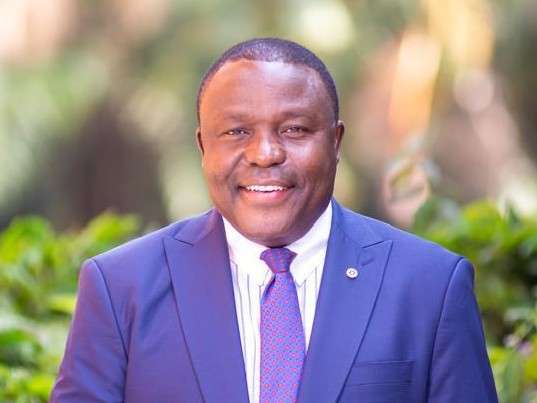
Leadership in Africa is often shaped by global templates, but Milton Owor, chief people and culture officer at Uganda’s National Social Security Fund (NSSF), believes real transformation starts at home.
That belief is shaped as much by his personal routines as by his professional life. When the week winds down, Milton gravitates towards spaces that allow him to reset and reflect.
“I love going to the gym. It’s a quiet space to just be myself and do things,” he says, describing exercise as both discipline and release.
Milton is active in Rotary, values fellowship and service, and, when time allows, enjoys a round of golf. Reading, however, remains a constant. At the time of the interview, he was immersed in The Power of Habit, a book that echoes his long-held interest in human behaviour.
Leadership begins within
“If you decide what sort of human being you want to be, what sort of leader you want to be, you’ve got the power to choose what habit to develop,” Milton explains, returning again to the idea that lasting change, in people and organisations alike, is built quietly, one repeated choice at a time
Milton believes that Africa’s future must be led by Africans, shaped by its people and rooted in local realities. His conviction is rooted in years of experience across multinationals, including British American Tobacco from 1991 to 2005, Royal Dutch Shell from 2007 to 2013 and General Electric Company (GE) from 2014 to 2015.
In 2016, Milton joined NSSF to head the development and delivery of the fund’s human capital strategy, centred on optimising talent and driving a high-performing culture.
“Everywhere I’ve worked, I’ve seen incredible skill and resilience among African professionals. What holds us back isn’t ability. It’s the mindset that great leadership or great systems must come from somewhere else,” Milton says.
This mindset didn’t change overnight. His early years at British American Tobacco taught him structure and precision but also raised questions about the fit of global systems in African environments.
“The environment was highly structured. It taught me the power of process and that success isn’t random. But I began to wonder whether systems built in London or New York can work exactly the same in Kampala or Nairobi,” he recalls.
Rethinking imported systems
While BAT taught him discipline, data and execution, he also saw how local nuances could influence the success of any framework.
“You can have the best strategy on paper, but if it doesn’t speak to people’s lived experience, it won’t move them,” Milton notes.
It was during this early stage that he began to understand the tension between imported practices and local authenticity. Africa’s business landscape, he came to believe, demanded a balance; not rejection of global models, but thoughtful adaptation of them.
“Global exposure is a gift,” he says. “But it’s only powerful if you use it to strengthen, not replace, local capability.”
As his career advanced, Milton moved across industries and geographies, from the energy corridors of Shell and later Vivo Energy, to the innovation-driven culture of General Electric (GE). Each role stretched his perspective, challenging him to blend global best practice with regional identity.
“Working for multinationals gives you great tools, structure, governance and efficiency. But success here depends on how deeply you understand the context,” he adds
During his years at GE, Milton was struck by how leadership was often shaped by data and metrics, critical tools, but not the full picture. He noticed that the most effective African leaders were those who could merge analytical thinking with cultural empathy and adaptability.
“People in Africa value connection. You can’t lead here purely by dashboard. You lead by listening, by being present, by understanding what drives your people,” he observes.
Leading through connection
At Vivo Energy, this philosophy deepened. Leading diverse teams across several countries, he found himself bridging worlds, global headquarters with regional realities, strategy with empathy, ambition with understanding.
“It’s not about rejecting what the global system teaches. It’s about saying: this is valuable, but it must speak our language. Leadership has to look and sound like us,” he clarifies.
By the time he joined NSSF Uganda, Milton’s perspective was clear. Imported formulas would not drive transformation – local leadership would.
“When I came to NSSF, I brought that philosophy with me. We’re building something for Ugandans. Our leadership pipeline has to reflect that. It’s about finding talent that understands the rhythm of this country, its aspirations, challenges and potential,” he explains.
Under his leadership, the fund has focused on developing people internally and creating clear pathways for growth and succession. But Milton stresses that localisation doesn’t mean closing off from the world.
“You don’t localise by shutting doors. You localise by opening them to your own people, by giving them the tools, exposure and confidence to lead,” he emphasises.
For Milton, the mission goes beyond talent development. It’s about rewriting the story of African leadership, replacing dependency with confidence, imitation with originality.
“Too often, we benchmark ourselves against systems that were never built for our environment. We need to measure success by how well we serve our people, not by how closely we mirror someone else’s model,” Milton states.
Redefining African leadership
While his role includes culture, Milton insists that culture is the organisation’s spirit, something that must be felt, not just planned. He advises leaders to prioritise listening alongside planning.
“You can digitise processes and automate workflows, but if people don’t believe in what you’re building, transformation won’t happen. Leaders need to be comfortable with humility. You don’t need to have all the answers. Sometimes your team already does,” Milton observes.
He adds that the next era of African leadership will require courage, especially the courage to lead differently, pointing to Africa’s young population as the continent’s most important resource.
“We have a generation that’s globally connected but proudly African. If we give them the right skills and belief, they’ll redefine leadership for the next century,” Milton says.
He adds that the best leaders will combine discipline with empathy, and ambition with service. Looking back on his own career from multinationals to national service, Milton remains focused on one principle, progress: must begin from within.
“The best leaders don’t just manage outcomes. They inspire ownership. They make others feel seen and capable. Our growth story starts here,” he notes. “Africa doesn’t need to wait for validation. We already have the knowledge, the people and the heart to lead ourselves.”