
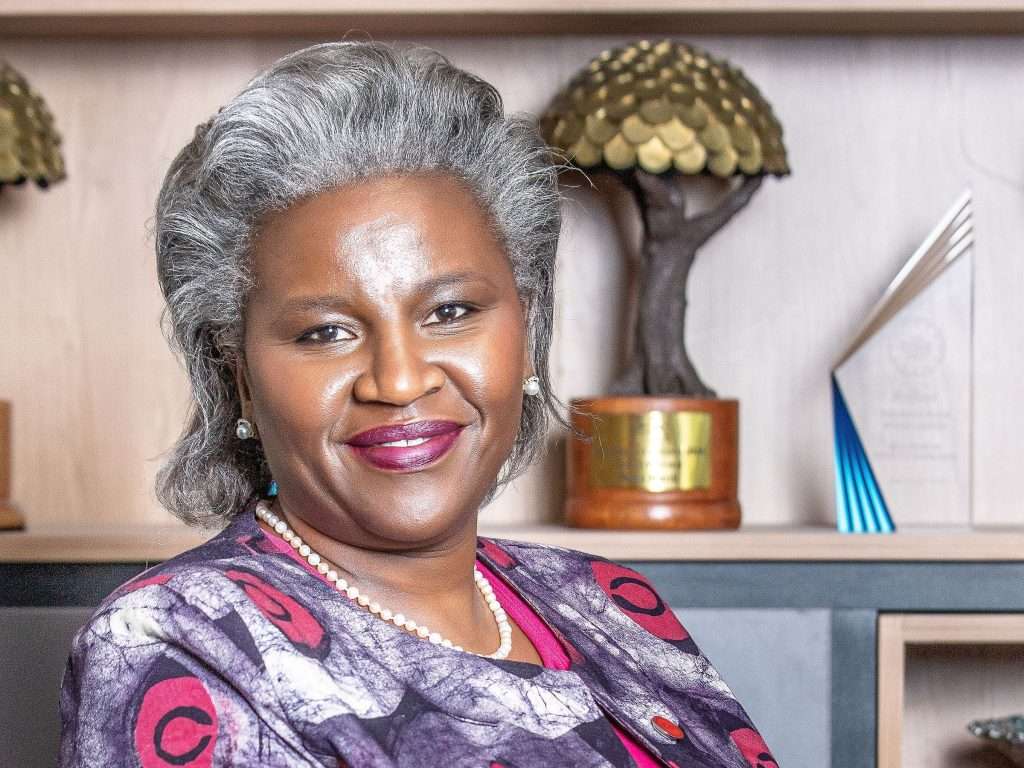
Mumbi Kahindo sees the HR seat at the executive table as something built step-by-step, decision-by-decision. She believes the role is about bringing a human perspective to business, listening to people across generations and shaping decisions.
The way Mumbi Kahindo, chief people officer at Absa Bank Kenya, describes herself reveals a great deal about the role she has spent two decades trying to redefine. She makes it clear, with careful distinction, that the HR role has transformed to be more of a business leader who brings a human capital perspective.
“The distinction matters to me, and reflects how both my previous and current line managers have framed my role,” she says. “I was hired not as a technical human capital professional, but as a business leader with human capital capabilities, someone who understands the commercial context brings the human capital perspective to business decisions.”
Mumbi sits on the country management committee, and has spent 13 years at Absa. Prior to that, she spent a decade at Deloitte where she had various roles in human capital in East Africa and globally.
She is the eldest in her family, and grew up in the hills of Murang’a. She speaks warmly of her father as one of the earliest architects of her ambition. Her mother would teach her resilience and the values of hard work as she grew older.
“From as long as I can remember, my dad set such high standards from an education perspective and what I could become. He was the source of my inspiration, a man who spoke about education and standards so consistently that the standards became internal,” she says.
Even as a young girl, Mumbi had a clear picture of what aspiration looked like. On her way to school, she would notice a woman in the neighbourhood, always smartly dressed, always purposeful, on her way to work. To a child, that image became a symbol of possibility.
“For me, the stockings worn by that lady represented possibility, and I thought when I grew up, I would work at an office and wear stockings like her. Now I do wear stockings,” she laughs. In that simple image was a larger dream: to grow into a woman of substance, dignity and professional purpose.
Mumbi studied secretarial studies in high school, mastered typing on a typewriter, and graduated among the top in her class. She later joined Kenyatta University, where she pursued a Bachelor of Education and graduated with honours, but despite her clear competence in this space, this was not to be her path.
“I remember the Teachers Service Commission (TSC) coming to our campus as they did every year and handing out application forms for placements. I held mine and could not bring myself to sign it. Something in me told me that I was destined for a different path, in an office” she said.
Mumbi chose to follow a conviction that her future would unfold differently.
PwC opened that door when they visited the campus looking for graduates. After the selection process, she joined the firm in the administration function and later moved into human consulting, where her interest in salary surveys, reward, organisational design and people strategy began to deepen.
“That was where HR found me, not the other way around. I grew curious about reward and remuneration while engaging HR professionals from other companies through the PwC salary survey club. I would later be involved in designing and selling training programmes,” she recalls.
A former colleague at PW later invited her to join Deloitte to help build out the human capital function, and she accepted. It became a defining chapter in her career
“She said she had work and she knew we could do it, and asked if I was interested to join,” Mumbi says. “That is how I got in, and began core technical HR work at Deloitte.”
A seat earned through credibility
Mumbi spent nearly a decade there, moving from East Africa to a pan-African role, and then to a global assignment based in New York where she completed a Master’s Degree in Strategic HR. That combination of African grounding and global exposure strengthened her ability to navigate complexity with confidence. When she returned home, she joined what was then Barclays Bank, now Absa, where she continues to contribute.
The question of whether HR belongs at the executive table is one Mumbi has strong views on. Her position is that the seat is not a right, and that credibility comes from commercial understanding, intellectual depth and the ability to contribute meaningfully to enterprise decisions. She watched it happen at Deloitte through her line manager.
“We built such value at Deloitte that it was important for us to be involved in critical decisions before they were made,” she explains. “Our perspective was sought after because there was value in our input. An HR leader at Exco level who cannot speak the language of the business, who does not understand a profit and loss statement, and who floats when the conversation turns to Finance, risk, or operations, will not hold the room for long,” she adds.
This lesson stayed with Mumbi, that people leaders hold their place in the room when their perspective improves the quality of decisions.
Soon after joining Absa’s executive committee, she intentionally sought to understand mechanics of business more deeply, sitting with colleagues to learn the language of financial numbers, market risk and building fluency in how performance is measured and what drives value creation in a financial institution.
“I can speak to the P&L, and while I may not know all the technical things like an accountant, I will tell you about our overall performance, including leading and lagging indicators. I encourage colleagues in the profession to upskill themselves on matters of finance, by attending courses such as finance for non-finance managers, or go to your CFO and ask them to explain the numbers to you,” Mumbi advises.
The reason Mumbi approaches the CHRO role in this way is usefulness rather than status. Today, that breadth allows her to engage confidently on performance, productivity and the organisational conditions that enable sustainable results. She aims to be head of the human capital function who shapes better business decisions and helps leaders see the full cost or value of their choices through both a commercial and human lens.
“When I challenge some of the thinking, they see that I understand what the business is trying to accomplish, but I also show the impact it will have,” she explains. “In those business conversations I make the case that employee engagement, leadership quality, and wellbeing are not soft issues, but core drivers of performance.”
Listening across generations
Mumbi notes that part of the work of building an enduring, people-first culture involves understanding employees across generations. Within her team, she has several Gen Z employees, who are between 24 and 32 years old.
She has instituted quarterly, skip-level meetings for her team members, creating a space for open-mic conversations. She pays close attention to the hopes, anxieties and expectations of younger employees, recognising that the future of work cannot be shaped with yesterday’s assumptions. This generation challenges her thinking and sharpening her people strategy.
“I do not think they are difficult. I just think we are impatient with them, because they are impatient with their lives, and they want things quickly,” she explains. “There was a day I went out to the lawn at lunchtime and sat with a group of Gen Z employees from various teams. One of them, who was around 28 years old, was trying to work out how to start a family on a salary that had not yet grown to where he needed it, and he was not complaining, but rather calculating how to chart their future.”
That conversation stayed with her, and she walked away wondering whether organisations with rich heritage are responding fast enough to the evolving needs of this new generation by offering flexible career pathways for growth outside the standard mould. Mumbi is part of a generation of leaders rethinking how institutions can remain structured without becoming rigid.
“How do you change an organisation that has years of structures and hierarchy now embedded, and how do you break those to allow this young generation to have a fluid career and make transitions more easily?” she questions.
This is a matter that Mumbi is working on without losing focus on the needs of all the other generations in the workplace.
Life beyond the office
Beyond boardrooms, organisational charts and executive meetings, Mumbi’s life unfolds in calm, personal rhythms. As a self-described homebody, Mumbi labels herself a genuine, reflective, almost introverted person. She confesses to reading many books at any given time, enjoys hosting family and friends for meals and keeps a Bluetooth speaker close in the house because music is inseparable from how she thinks, rests and prays.
“I grew up in a family that sings and loves to dance, and I believe I might have become a musician if I’d had the resources for a career in music. The proof of that love is that I flew to Australia on holiday recently just to sit inside the Sydney Opera House for an evening of a live orchestra performance. This had been in my bucket list and hence this was a moment of deep personal joy that reflected my love for harmony and excellence,” she says.
Her faith is the compass that guides her success. Through her church’s women’s ministry, Mumbi participates in prison visits and mentoring of teenage mothers where she spends time listening, encouraging and extending dignity to whose lives have taken undesired and painful turns.
“Prisoners are human beings; they miss their children’s graduations, and the connection with their families. They too had dreams. One has more grace, more compassion when you engage them. Hearing some of those stories has taught me humility and made me realise that maybe if I was in the same circumstances, I would not be here. But for the mercies of God,” she says.
According to Mumbi, the prison visits have changed the way she sees life. When she goes back home, she is able to talk to her son, nephews and her friends’ children about choices, consequences and character.
“It is a privilege and noble duty to pour into the lives of these youth and hopefully help them navigate the complexities of life,” she says.