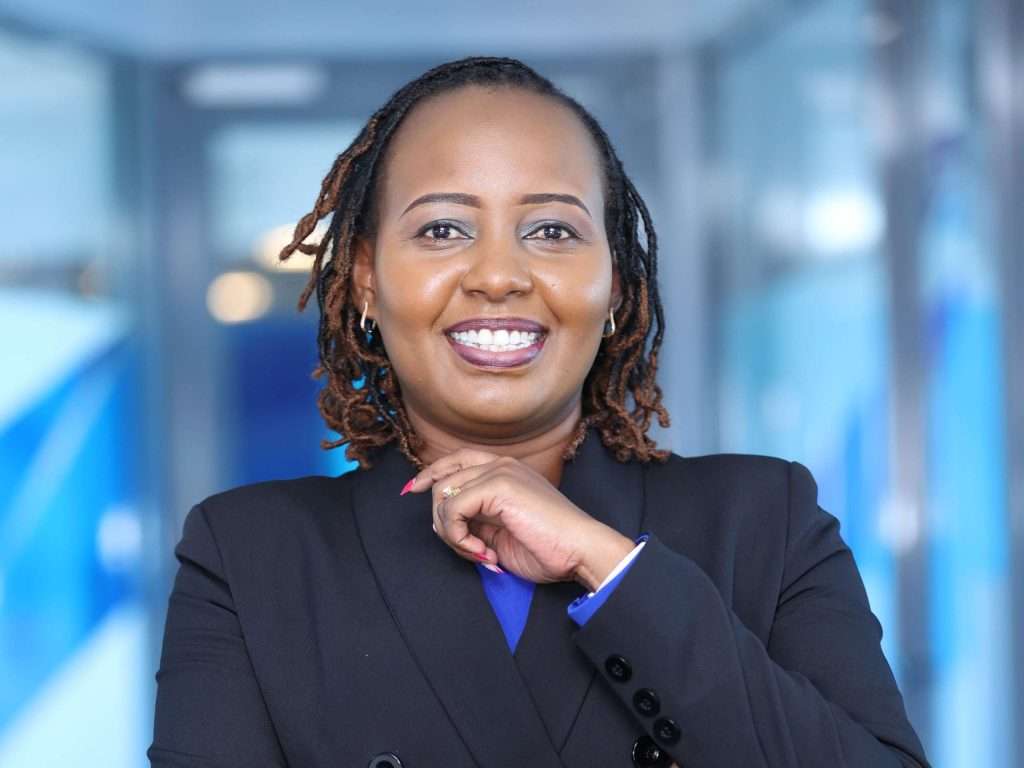
Rachel Kanyolo is shaping workplaces where people feel heard, respected and supported. Guided by balance in her own life and strong relationships, she brings empathy and clarity to both her work and the people around her.
From Monday to Friday, Rachel Kanyolo ends her working day at a dance studio near her office, choosing Zumba, Pilates or simply open dance over the traditional treadmill. She moves through the week this way deliberately, because the operational nature of human resources means she spends most of her day seated at a desk, and the physical movement provides the mental clarity her demanding role requires.
“I feel like when I exercise, I think much clearer and much better,” she says. “We spend most of the day seated, so if you are not intentional about it, you end up getting a sedentary lifestyle and it ends up affecting you, so in the evening, even if I do an hour, that is enough.”
Weekends belong to her family and her long-standing friendships. She has friends that have now evolved into a sisterhood that she has known for twenty years. This sisterhood has been a constant presence in her life and has helped her navigate the various seasons of adulthood over the years. She also has a chama, a group of women with a shared purpose that visits parents together every month, a small act of gratitude for the paths they have all been able to walk. Her children have Saturday classes, swimming or football, and her mornings are built around getting them there.
“I’m not someone who keeps work and life in separate boxes. I’ve learned, over sixteen years in HR, that the quality of what I bring to one depends heavily on what I give to the other,” she adds.
From IT to people leadership
Rachel is people and culture manager at the Kenya Association of Manufacturers (KAM), a business membership organisation that supports manufacturers across Kenya and the wider East African region. Her background, unusually, began not in HR but in IT. She studied business computing at university and her first job was where she was placed in an admin function.
“It was there that my interest in people first emerged. The organisation was just getting started and everyone was building something. I was handed the HR function almost by accident and quickly realized that I did not want to let it go. It is during that stint that I realised I needed to go back to school and get a bit of understanding on how to run a HR department," she recalls.
She completed a postgraduate diploma in HR and never returned to IT. She stayed at that particular organisation for eight years, building the HR department from drafting and implementing policies, contracts, job descriptions and the full employee lifecycle. When she eventually left in 2018, the function was running.
“What followed was a career shaped by movement and variety. I spent eight months at a tracking organisation, stretching myself across both HR and an executive assistant role, before the demands of a young family made the pace unsustainable,” she notes.
She moved into consultancy, joined Mammoth East Africa, and found herself working directly inside manufacturing companies including a cement and aggregate business with eight sites across Kenya, setting up HR departments in organisations that had operated for years with nothing formal in place.
“Getting to know people up to the grassroots, the people who actually blast the aggregate, I think is what has made me who I am today,” she reflects.
From there she moved to a corporate training organisation running a Mastercard Foundation project, the Young Africa Works programme, and Family Bank Foundation Project, where she managed hydroponic greenhouse projects and trained young beneficiaries in safeguarding. She trained women in construction trades, plumbing, electrical work, masonry, carpentry and became a full-time safeguarding facilitator alongside her HR role.
Leading with fairness and dignity
Rachel’s work also focuses on managing employment changes in a way that respects people’s dignity. She knows what the wrong version looks like. When she was working in a manufacturing consultancy, she was brought in to handle redundancies at a production facility. The workforce was mostly male, mostly young, and entirely unprepared for what she had to tell them and some of them nearly turned on her.
“You're a lady and the rest are men and going to work the next day you're wondering: how am I going to walk through that gate and go to my office?" she says.
She went back the next day and the day after that. What carried her through was a principle she had already formed and has held ever since.
“The process has to be visibly fair, the person in front of you has to feel heard, and the conversation has to make clear that the decision is about the organisation's position, not a judgement on the individual. We are not able to support everyone. But that said, we are going to compensate you for your time here. So, we are ensuring that that process is fair because we are all human,” Rachel notes.
The result surprised her. Conversations that she had expected to stay hostile became something else. People who had come into the room furious left understanding. Some of them told her they would want to work with her again if circumstances changed.
“For me, the decision to terminate is always the last step, and it should only be reached after every other option has been exhausted,” she adds.
Where performance is the issue, she starts by questioning the system around the employee rather than the employee alone. Is the manager giving clear direction? Are the targets reasonable? Has the organisation actually tried to support the person, or has it simply watched them fail and documented it?
“Sometimes the issue is their manager or their supervisor,” she says. “You speak to the supervisor and you speak to the employee and understand both ends. We are no longer in the age of personnel where management said you're wrong so you're wrong. No, you have to understand both ends.”
Where conduct is the issue, Rachel says the same interrogation applies. If someone has been coming to work under the influence of alcohol, the question is not only whether they have been warned enough times. The question is what is driving the behaviour. Has the organisation offered therapy? Has it offered support? Has it given the person a genuine opportunity to change?
“Even when someone has committed gross misconduct, how you handle the situation makes all the difference,” Rachel observes. “I ask myself whether I’ve explored every option with the employee. If the issue is drinking, what is causing it? Is it related to family circumstances, or is it something personal to the individual?”
Rachel is planning on pursuing her master’s degree, a key priority for her this year. On a personal growth front, she looks forward to taking up golf, a passion her husband has long encouraged and engaging more actively in business communities where she can benefit from peer learning and shared expertise.
As John C. Maxwell said, “Growth is the great separator between those who succeed and those who do not.” Rachel’s commitment to continuous learning and leadership exemplifies this truth.