
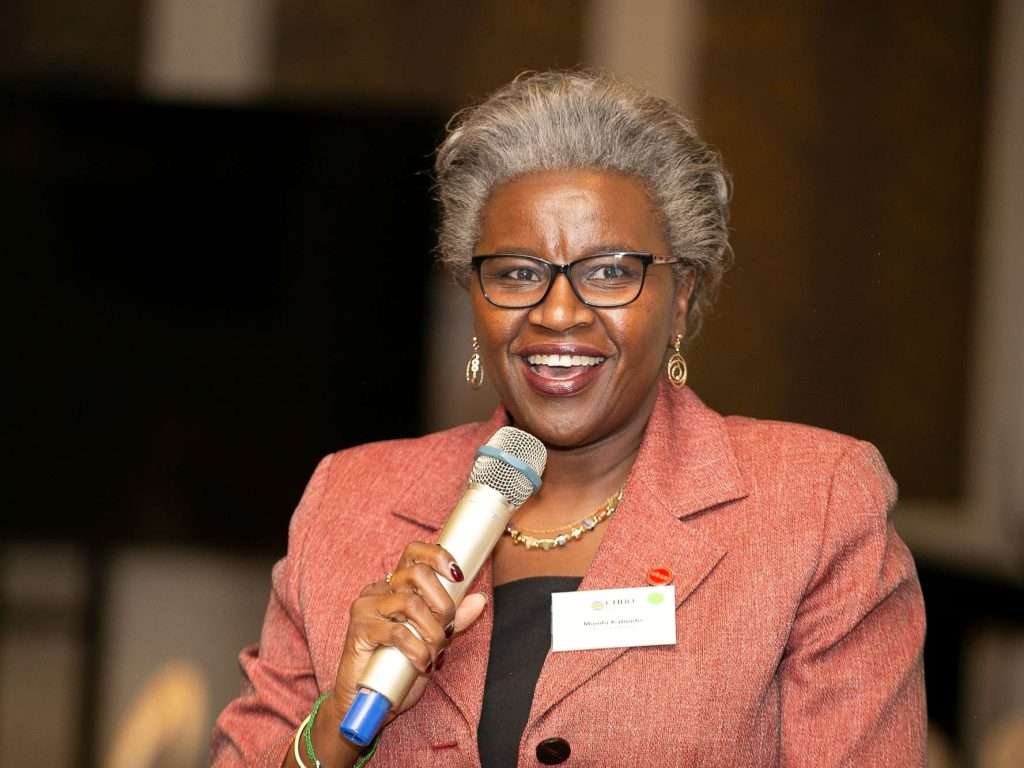
At the CHRO East Africa Summit Launch held at Villa Rosa Kempinski Nairobi, Absa Bank Kenya CPO Mumbi Kahindo gave a future-forward keynote address of what CHROs can focus on to cope with evolving demands of the modern workplace.
When Mumbi Kahindo stood to address dozens of chief human resource officers at the CHRO East Africa Launch Summit, she began by painting a picture of how far the HR profession has travelled, and how much it has changed along the way.
“When we started, we were called personnel officers. You had to make sure that you had good files for your employees, knew at least a bit of typing, understood how leave is calculated, and had an appreciation of what a contract is. If you worked in an environment where there was overtime, you knew how to do that,” she recalled.
Mumbi, who is the chief people officer at Absa Bank Kenya, has spent more than 25 years in the HR profession, long enough to have watched HR evolve from a department under finance to getting a seat at the top table.
"When I see the complexity of the environment that we are now living in, and the demands of the evolving workforce that we have to deal with, it continues to affirm to me that the only way that organisations will thrive is when their people thrive," she said.
At Absa, keeping pace with that complexity means an annual strategy review, in which Kahindo and her team assess what is working in the bank's people strategy and what isn't. With this year's review just weeks away, Mumbi used her keynote to share the four priorities currently shaping her thinking.
Tech-driven change
Top of Mumbi's framework was artificial intelligence, which she said is already transforming how people work. As a result, she believes continuous employee training is non-negotiable.
"Hiring alone cannot keep pace with this change, and that's the truth. You've got to realise you will not find enough capability that is ready to deliver for your organisation with the right level of competence out there. Therefore, you must build a culture within your organisation that seeks to continuously develop your people," she said.
Even so, Mumbi was adamant that AI will not replace the human workforce, as some quarters have feared.
"As technology advances, human capabilities such as empathy, judgement, collaboration, and ethical leadership become more valuable, and that's why AI cannot beat humans. The differentiator going forward for our leaders is going to be judgement, because a human can perceive a lot of information that surrounds them that an AI may not be able to perceive," she said.
The retention conundrum
If technology is reshaping how the workforce operates, retention has proven to be a major problem for most HR professionals. Nevertheless, Mumbi was quick to point out that retention is never just about pay.
"I can give you a 40 percent increase, it changes your life, but in three months your expenses rise, and you're back to telling me you don't think you're well paid," she said.
Rather, Mumbi argued that employees stay where they find purpose and belonging.
"Employees will continuously seek meaningful work, career growth, flexibility, strong leaders, and a sense of belonging," she said. The realisation came after observing how her son handled an opportunity he had gotten for an internship with a multinational company.
She recalled: "When my son finished campus, he got a call from a good multinational. He is a football player and had just joined a football academy. When he got the call to go to the office, the contract was ready for him to start an internship the following week. However, he told the business partner who engaged him, 'Unfortunately, I need to reflect on this, because I've just committed myself to the academy.”
For Mumbi, the incident was eye-opening because it showed her that younger employees are looking for fulfilment and belonging above all else. While she admits that she still hasn't worked out how to help younger employees fit into her own organisation, she remains convinced that retention comes down to understanding people well enough to create real value for them.
She is also a big advocate of employee wellbeing and encouraged HR professionals to support their employees' mental, physical, financial, and emotional health as a way to build resilience. She was equally firm on diversity, arguing that varied teams bring broader perspectives, drive innovation, and ultimately strengthen organisational performance.
Resilient leadership pipelines
Hiring and training capable employees, according to Mumbi, is only part of the framework.
"Everything in a company rises and falls with leadership," she said, arguing that strong organisations are built by capable leaders through deliberate pipelines that prepare the next generation to take over.
"This means identifying and developing future leaders, exposing them to diverse experiences, and supporting them through mentoring, coaching, and development opportunities," she said.
She also urged HR professionals to embrace inspirational leadership by communicating vision consistently, connecting with employees on a personal level, and building a shared sense of purpose so that everyone is rallying towards a common goal.
For Mumbi, the future belongs to organisations that invest in people as much as they invest in technology.
"The organisations that will succeed will not simply be those that have the best technology, but those that are best able to prepare their people to learn, adapt, and lead through different challenges," she said.